Pragmatica Aether

Distributed Java runtime with predictive autoscaling. The third option between monolith and microservices. Write business logic, deploy distributed.

The Problem

Monoliths are simple but don't scale. Microservices scale but bring operational complexity — Kubernetes, service mesh, distributed tracing, configuration management.

Teams spend more time managing infrastructure than building features. The complexity that was supposed to help becomes a burden.

There should be another way.

The Solution

Aether is a distributed Java runtime that handles the hard parts for you. Write your business logic as "slices", deploy them, and let Aether manage distribution, scaling, and resilience.

No Kubernetes. No service mesh. No YAML sprawl. Just Java code that runs distributed when you need it to.

Built-in observability, predictive autoscaling, and zero-downtime deployments — out of the box.

Key Features

P

Predictive Autoscaling

ML-based scaling that learns from traffic patterns. Scale before the load hits, not after.

  • 2-hour sliding window analysis
  • Pattern recognition for traffic spikes
  • Preemptive scaling decisions
  • Decision tree fallback for reliability
O

Full Observability

Understand your distributed system without bolting on additional tools.

  • Per-method invocation metrics
  • Prometheus endpoint built-in
  • Configurable alerts and thresholds
  • Real-time dashboard
R

Rolling Updates

Deploy new versions with zero downtime and full control.

  • Two-stage deploy/route model
  • Weighted traffic shifting
  • Health-based promotion
  • One-click rollback

Production Validated

Aether is tested with a comprehensive E2E suite covering real production scenarios.

  • 80 end-to-end tests across 12 test classes
  • Cluster formation and leader election
  • Node failures and recovery
  • Network partitions and split-brain
  • Rolling updates and traffic shifting
  • Chaos engineering scenarios

Simple Setup

Get a cluster running in minutes with aether-up.

  • aether-up — generates Docker Compose or Kubernetes manifests
  • aether-cli — REPL and batch operations
  • 30+ Management API endpoints — full programmatic control
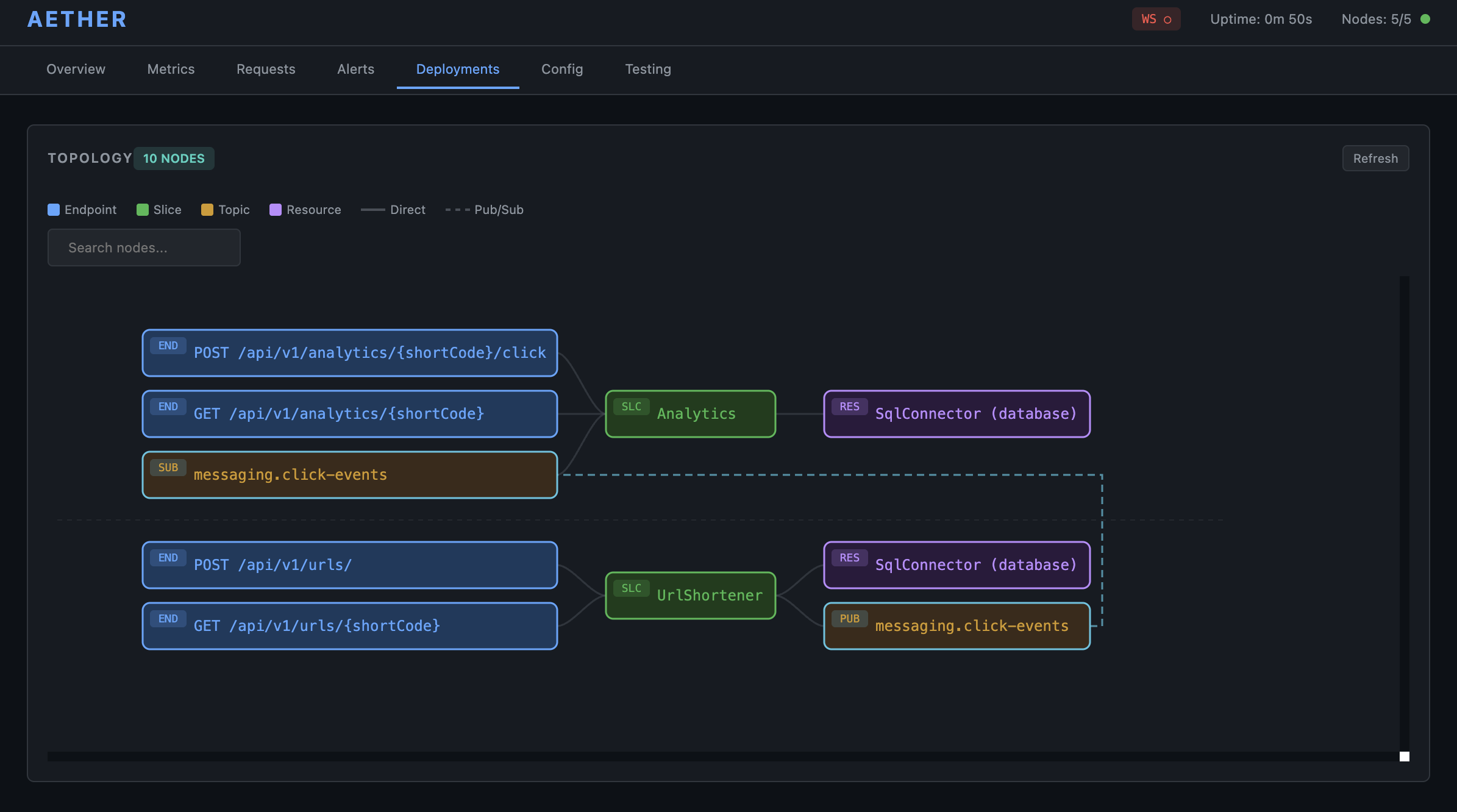
  • Aether Forge — local development with visual dashboard

Aether Forge

Local development environment with visual dashboard for testing distributed behavior.

  • 5-node simulated cluster
  • Real-time metrics visualization
  • Load generation with configurable rates
  • Chaos injection (kill nodes, inject latency)
  • Test resilience before production

Use Cases

  • Growing monoliths — Scale without rewriting
  • Microservices fatigue — Simplify operations
  • New distributed systems — Start right
  • Variable load patterns — Predictive scaling handles spikes
  • Zero-downtime requirements — Rolling updates built-in

Licensing

Business Source License 1.1

Aether uses BSL 1.1, transitioning to Apache 2.0 after 4 years. This means:

  • Free for internal use — Use Aether in your organization at no cost
  • Free for non-production — Evaluate, develop, test freely
  • Commercial license — Required only for offering Aether as a service
  • Eventually open source — Full Apache 2.0 after 4 years

Why BSL?

BSL protects our ability to sustain development while keeping Aether accessible. Large cloud providers can't wrap and sell it, but you can use it freely for your applications.

It's the same model used by MariaDB, CockroachDB, and other successful projects.

Pilot Program

We're looking for pilot partners to deploy Aether in production.

What You Get

  • Direct access to the development team
  • Priority support during pilot
  • Influence on roadmap
  • Favorable commercial terms

Ideal Pilots

  • Java backend with scaling challenges
  • Microservices complexity pain
  • Team willing to try new approaches
  • Production deployment target

Resources

GitHub

Source code, documentation, and examples.

View on GitHub

Current Version

Pragmatica Aether 0.7.1 — Production-validated, 80 E2E tests, predictive autoscaling.

Questions?

Let's discuss if Aether is right for your use case.

Contact Us